Each time I learn something I realise how many things I do not know and will never know, which makes me sad. I reckon it is the counterpart to the joy I feel when I learn new things...
Monday, 2 November 2009
The more I know, the less I know


Monday, 6 April 2009
Grand Theft Auto Cars and their real world couterparts (part 1)
Since I got my first copy of Grand Theft Auto in 1998 -yes, the original one, the one with the zenithal viewpoint- I’ve always tried to find resemblances between cars in the game and real world cars. Well, since now I’m hooked to the latest version of the series I’ve decided to find the resemblances between cars in the game and their real counterparts. So here goes the first lot of comparisons between them, with pictures showing them together to ease your opinion when deciding if Grand Theft Auto’s IV designers and programmers got inspired by my choices or not.
Since I’m European I don’t know much about American cars, so if anybody has suggestions please let me know and I’ll put it in one of my next posts.
Blista Compact

Cavalcade

Cavalvade FXT

Patriot

Saturday, 31 January 2009
Curious Google Earth snapshots
Sunday, 18 January 2009
KML and KMZ Benchmarking
When displaying data over Google Maps using KML and KMZ files there is always the doubt of whether it is better to use one type of file or the other. KML is the standard XML type file used by Google to display data over their maps, while KMZ is a compressed KML file. Compressing a KML file dramatically reduces its size, for example in the example used to a 26.22% of the original size, helping to save the typically scarce server space. Even though, less space does not always mean faster loading times, because it is necessary to uncompress the files, which may take a long time.
| File | KML | KMZ |
| Number of polygons | 2103 | |
| Size in KB | 5.705 | 1.496 |
| Relative size (%) | 100 | 26.22 |
| Loading time (sec) | 28.94 | 12.1 |
| Relative time (%) | 100 | 41.81 |
| Software used | Google Earth | |
| Version | 4.2.0205.5730 | |
| OS | Windows XP SP2 | |
| Processor | Intel Pentium M 1.73 MHz | |
| RAM | 1GB | |
| Web Browser | Internet Explorer | |
| Connection speed | 2MB/sec Cable | |
| Files hosted at | www.gisngeo.com | |
This is the file used to do the benchmarking:

Friday, 17 October 2008
Crisis (2): 1929
Article written by Xavier Sala Martí (Columbia University) in La Vanguardia, a Catalan newspaper. Translated from Spanish to English using Babel Fish (sorry for the translation mistakes, if you want to suggest any change leave a comment).
The global financial crisis has sown panic about the state of the global economy. Many analysts compare the situation with the Great Depression of 1929. We remind investors episodes of rushing through the windows on Wall Street and queues of hungry Americans begging on the streets of New York. Even my colleague from Columbia, Joe Stiglitz, said that the fall of Wall Street capitalism is what the fall of the Berlin Wall was to communism. Stiglitz's words are a great intellectual contribution to the debate, because it demonstrates once and for all that the prize awarded to Nobel no vaccine against the ability to say nonsense.
Let's see, let us be serious: neither the financial crisis represents the end of capitalism or we face a new Great Depression. The current situation resembles that of the 29 in two essential aspects. The first is that stock markets have fallen. Yes. So what? Many people have lost money and that's sad. But from there to be a looming Great Depression half an abyss. Statistically, short-term movements of stock markets do not reflect the real state of the economy, especially during episodes like the current ones, in which investors have entered the stock market in a state of hysteria that prevents them from seeing things clearly.
That said, there are six major differences between the crisis of 1929 and the present. First: in 1929 the bank deposits were not insured.
When the crisis began, all the families rushed to find their savings to their banks. These, of course, did not have the money because it had provided (that is, precisely, their business), so they could return and were left without resources when the doors closed. Millions of Americans lost their savings. None of this will happen in 2008 because the deposits are insured, precisely, thanks to the lesson of 1929.
Second: in 1929 the monetary system was based on the gold standard, which prevented the Federal Reserve (FED) increased liquidity in the system if not previously increased its reserves of gold. As the gold held by the Fed did not increase, this could not print the money that disappeared because of bank failures. In 2008, central banks around the world are printing money to provide liquidity to the financial system.
Third: in 1929 there was deflation and prices and wages were falling continuously. That meant that the debts were inasumibles family: if one has a debt of 100 and a salary of 300, one can pay.
But if the wage goes down to 100 and the debt remains the same, one ends up not being able to pay. That worsened the financial problems of banks. In 2008 not only there is no deflation but there is inflation.
Fourth: the per capita income of U.S. in 1929 stood at about 6,000 dollars (in current prices). Today exceeds $ 36,000. A fall in income from 25% when you win 6000 poses serious problems of famine. The same drop when you win 36,000 is a problem, but does not generate humanitarian disasters.
Fifth: the U.S. reaction to the crisis of 1929 was to blame foreigners and promote purchases of American products by putting tariffs on imports (the infamous Smooth-Hawley tariff). Naturally, the reaction of foreigners was put tariffs on American products, which triggered a trade war that harmed at all. At present, despite some remaining globófobo haggard (and hairy), there are no documented economists propose protectionism as the solution to the crisis.
And sixth, and most importantly, there is a fact in which almost no one fixed but it is key: the rate of return on investment of non-financial sector. In the year 1929, that rate was 0.5%. That is, in 1929, if one was investing an U.S. dollars outside the banking sector, earning a return close to zero. In 2008, return on investment in non-financial sectors is ... 10%! To become an idea, the rate of return average for the past 50 years has been 7%. This is very, very important, because while economic growth in a country not preceded by increases in the bag, yeah ... has been preceded by high rates of return in the financial sector! To understand: While Wall Street has done its financial follies, Silicon Valley has continued to innovate, and that, ultimately, is what determines the growth of the economy. That means that when the financial regain sanity, capitalism not only not disappear but that the U.S. economy will come out fired toward a new growth path.
Ah! I almost forgot. I said that there were two factors that made the crisis of 1929 and the present were similar. I have one already commented: stock markets plummeted. The second: governments do not learn anything. One is left stunned when the Government approved a plan to purchase 700,000 million toxic assets of banks and a week later decides that the money will be used to buy shares. And one becomes even more petrified when he sees that the explanation given for this change is that ... the stock market has reacted negatively! That journalists will confuse the bag with the economy takes a pass. But the government used the bag to decide its economic policy is crazy that shows that he totally lost. Tan lost as of 1929.
Crisis (1): What has happened
Article written by Xavier Sala Martí (Columbia University) in La Vanguardia, a Catalan newspaper. Translated from Spanish to English using Babel Fish (sorry for the translation mistakes, if you want to suggest any change leave a comment).
The perfect storm continues its inexorable course and we all wonder what is the solution. Before talking about remedies, it is important to know what has happened because, without a proper diagnosis, there is no sensible solutions.
It all began in 2001 when Alan Greenspan wanted to avoid the collapse of the stock market after the fiasco of the dot-reducing interest rates from 6.5% to 2.5% in less than a year. With these guys so low, banks, who live in lending money in exchange for an interest, sought profitability in families with low incomes and with a high probability of being unable to repay the mortgage, calls families have an increased risk subprime.Al, those families pay a higher interest, although the banks thought the risk was mitigated by the fact that the price of their houses were going up: if one day they have problems, they thought, the families will be able to sell the house at a price higher than the mortgage, enabling them to return the money.
But they could charge the margins were so small that in order to obtain profitability, they had to multiply the volume. The problem is that the number of mortgages they could give was limited by regulation to Basel prevents credits granted by a bank exceed a certain proportion of their capital. Curiously, which does allow such regulation is that banks think about parallel investment funds (called under pressure) who buy their receivables. And so they did: the calling given under pressure, buying mortgages to the banks and those recovering the money. Having disappeared from their credit balances (to allow regulation and the Basel accounting of the bank and the conduit was made separately), banks could return to provide the same money, thus expanding the business.
The under pressure, in turn, the Prime Minister took the mortgages, the repackaging (in sophisticated language, title) in ways so complex that get ratings of AAA, which indicated minimal risk and sold to investment banks. To facilitate the operation, even got names pompous as insurance with credit default swaps.Los investment banks, in turn, used these assets as collateral to borrow additional leverage and more financial operations, thus creating a huge snowball of assets , No matter how sophisticated they were, were guaranteed the last of the families subprime mortgages.
And all this was going very well while the price of housing rose. But came a day left to climb. Families who had borrowed 100,000 U.S. dollars saw that his house was worth only 60,000 and had to make a decision: return home or return of 60,000 a mortgage of 100,000. No one should be very ready to see that if the regulation allows to choose, many will return home and not pay the mortgage. And it turns out that the regulation allowed to pick and, therefore, decided not to pay the late payment was fired and all assets secured by those mortgages began to lose its value and to be cataloged tóxicos.El problem is that they had been so many times that retitularizados nobody knew how many active or toxic or who had had. That created a mistrust between banks that made money no longer lend to each other. Interbank interest rates (such as the Euribor) was fired and, with them, the monthly payments of millions of families who stopped to pay their mortgages. Late payments rose, no longer among subprime families, but among the families in the world. Insurers had to pay it insured ... but did not have enough money, so they were the first to break. Their names: Bear Stearns, Freddie Mac, Fannie Mae and AIG. Does it sound like?
And here again to see the regulation of Basel: the investment banks like Merrill Lynch and Lehman Brothers had used such bonds now that were toxic as financial security and the regulation said that when the value of those securities down, banks were required to dispose of other assets and use the money to replenish the lost security. The problem is that this was happening right in the moment that nobody wanted to buy those assets at reasonable prices. But as they were forced to sell, sell. That ... To balance price! That increased their losses, which reduced the market value of its assets, which forced them to sell more, which increased their losses ... and so on in a negative spiral of losses and decreases in trading that led to bankruptcy. The financial panic was served.
Which brings us to the present time: the mistrust, fear and loss of the banks are doing that not only cease to lend to other banks, but will cease to provide a non-financial companies from around the world. Investment in the hospital sector in Germany or the food in Colombia are not carried out due to lack of funding. Economic activity falls, the jobs disappear and what began as a problem in the U.S. mortgage. UU. is getting to the real economy around the world. The public asked their governments to act. The erratic public policies they propose, however, show that they do not know what to do, which raises more distrust and aggravate the situation. That's what we will talk in a future article. For now, this is what happened.
Tuesday, 9 September 2008
Former countries: Neutral Moresnet
Last week I visited a territory which used to be an independent country and not many people has heard of, Neutral Moresnet. It was rightfully labeled as a micro country, because only held 344 hectares within its borders and was home to 3000 inhabitants and a smithsonite mine. Its capital and only town was Kelmis. The country lasted independent for over a hundred years, between the napoleonic wars and WWI when it became part of Belgium. You can see a map of Neutral Moresnet in obtained from the Moresnet webpage:
 When I arrived to Kelmis I thought it would have some rememorance of its former independence. Pitifully, only a museum exists (at least this is the only thing I saw), but I would have appreciated to see at least a sign saying something like "You are entering the former country of Neutral Moresnet", because unless you are really aware of the existence of the country you won't know when have you entered the former country. If you look carefully you may still find some of the border markers standing.
By the way, if you are an esperantist you should go there since it was one of the main esperantist centers. It even was considered one of the languages of the country.
Tuesday, 19 August 2008
Fight, don't give up
 I thought I had an impenetrable computer, that no viruses could go through my defences but I was wrong. About two weeks ago I realised my CPU consumption arrived to 100% even right after having started the computer and without having turned any programmes on. It was fixed by resetting the computer, but one day the famous Windows blue screen appeared before the OS was loaded. It gave the following errors:
- Driver_IRQL_NOT_LESS_OR_EQUAL
- Srosa.sys
I tried to restart the computer but it appeared again, so I used my beloved Linux (Ubuntu) OS and made a backup of all important files into an external USB drive, just in case I had to format the hard drive. Then I tried to access Windows using the safe mode, but I got the same error. Luckily, I could access Windows using the last configuration which worked mode. Once in my desktop again I realised that all my anti-virus/firewall software did not work. What is worse, I could not install any kind of security device in my computer, it said that it couldn't communicate with the kernel or that the anti-virus X was not a Win32 application (yea right). The solution I found was to run some on-line tests like Panda Activescan, Norton or Kaspersky, which found tons of viruses, which is to be expected since I had been without protection for quite a long time, but they could not delete the main source of contamination.
I had been infected by a virus called Begle or Beagle (hence the pict ures), which is a trojan bastard son of his mother. It blocks all antivirus software and uses the computer as an e-mail server to spam as much as possible. Neither regular nor on-line antiviruses seem to be able to get rid of it. After fighting for a long time against it and not formatting the hard drive, though I was tempted to do so many times, I found a little piece of software which is marvellous. It's called ELIBAGLA and deletes the virus enough so you can install and run an anti-virus software which gets rid of all the remaining bits of the virus plus the ones which have entered after the AV software was shut down.
 ures), which is a trojan bastard son of his mother. It blocks all antivirus software and uses the computer as an e-mail server to spam as much as possible. Neither regular nor on-line antiviruses seem to be able to get rid of it. After fighting for a long time against it and not formatting the hard drive, though I was tempted to do so many times, I found a little piece of software which is marvellous. It's called ELIBAGLA and deletes the virus enough so you can install and run an anti-virus software which gets rid of all the remaining bits of the virus plus the ones which have entered after the AV software was shut down.
Even though, problems don't end here. When I tried to switch from LAN connection to Wi-Fi I found that my wireless didn't work. When I tried to select a network I read this message:
- Windows cannot configure this wireless connection. If you have enabled another program to manage this wireless connection, use that software. If you want Windows to configure this connection, start the Wireless Zero Configuration (WZC) service. For information about starting the WZC service, see article 871122 in the Microsoft Knowledge Base on the microsoft.com Web site.
- Type this in Start->Run... net start wzcsvc (this will activate your Windows wi-fi service)
- If now your Wi-fi works great, you don't have this awful virus. If you get the following message: 'Error 1068: The Dependency Service or Group Failed To Start' means that you are contaminated with Beagle, but don't worry, it can be fixed.
- Now to the tricky part. Go to Start->Run.. and type services.msc Then navigate your way to: HKEY_LOCAL_MACHINE/SYSTEM/CurrentControl/SetServices/Ndisuio Once you find it open 'Start' and type a 3 (you may have a 4, which is wrong) leave the radio button in hexadecimal. In the same folder open 'Tag' and change whatever you find (maybe e?) by the letter C, again leave the radio button in hexadecimal.
- Restart the computer and everything should work fine again
To finish the cleaning process just scan the whole computer with as many antivirus as you can, local and on-line ones, and install good up to date antivirus, firewall and antitrojan software. I recommend Nod32, Outpost and TrojanHunter. Also a registry cleaning using an appropriate program like Wise Registry Cleaner is advised.
This virus is amazing, I've just received a letter from my Internet provider, Virgin Media, saying that I have been sending huge amounts of e-mails and that I am either a massive spammer or that I have a virus, so they may shut down my Internet access. Well, not any more, my computer is clean as it was when I bought it, so don't worry mr. Branson, I won't be jamming your network any more.
I hope that if you have the same problem I had this posts helps you to fix it. If you have any suggestions please feel free to comment.
I hope that if you have the same problem I had this posts helps you to fix it. If you have any suggestions please feel free to comment.
Monday, 28 July 2008
Marginalised countries form list
 I am sick and tired of not being able to select Catalonia when an Internet form asks to select my country. This is why I have had the idea of creating a country list form so everybody can suggest their 'invisible' country and I'll add them into the list. I have started by adding Catalonia, Scotland, Galicia, Basque Country, Wales, Quebec, Corsica and Tibet, but there are dozens of other countries not recognised internationally which could be inserted into the list, so please suggest some and spread the word so no country in the world is missed from this list. Please feel free to copy it and use it in your websites so everybody can select their country and are not marginalised anymore.
 You can copy the code from here:
And see how it looks here:
Thursday, 10 July 2008
Mad with travelodge
 I have a job interview (wish me luck) in a city of the midlands and since I have to travel from Edinburgh to there and is over 400Km of journey I will have to sleep for one night there. When I was in Inverness I slept in a Travelodge and found it to be quite good value for money. Per person it was not expensive and the quality of the room, with TV, sofa and en-suite bathroom pleased me.
So, why am I mad with Traveloge I hear you say? Well, I have been trying to book a room for two hours and I still haven't been able to do so. I have tried using Visa, Visa Electron, Mastercard, Catalan accounts, Spanish accounts, Scottish accounts and nothing. Each single time I got an error message as feedback. It has been quite fustrating. What I will do, since Travelodge doesn't love me is book with my old French buddies of the Accor group. They have never let me down before.
Friday, 20 June 2008
Lights and shadows of Firefox 3
 Three days after Firefox's third version of the web browser release I think it is time to write a review about the new software. Downloading it was quite hard at the beginning, since it was released worldwide at the same time and with a lot of advertisement and expecting to achieve a world record for the largest number of downloads in 24h the servers collapsed. After three ours of failed downloads I managed to get my copy of the desired Firefox 3, but at a download rate between 5 and 20 Kb/sec, almost like when I was younger and I used a 56k modem. At least the nuisance was "worth" the wait, Firefox achieved the Guiness world record with over 8 milion downloads.
Down to the strict analysis of the software I must say the installation package (as it happened with the upgrade from 1.5 to 2.0) worked perfectly and it kept my bookmarked pages, my add-ons and even my tags intact, not a single change was made, which is great. It was also nice to have the Catalan verision of the software available from day one. I really like the default interface and I have grown accostumed to the new way tabs roll in a very short time. Navigation speed has improved as well, even though not as much in windows as it has in Linux.
But not everything is nice and I have already found several bugs. The first one is that, even though I have marked the option that warns you if you are going to close several tags from a browser window it never does. Firefox 2 worked fine with that.
One of the biggest drawbacks Firefox 2 had was the large ammounts of RAM memory it consumed, and it was announced that Firefox 3 would fix that problem. Well, it has to a certain extent, but has created a new one. I usually have between 50 and 70 tabs open at the same time, I don't like using bookmarks so I keep my favourite pages in tabs, not a good way to work but is how I do it. With so many tabs open it's ovious that the browser will have problems handling them, so Firefox 2 consummed around 400-600KB of RAM memory depending of the number and type of tags I had open. Well, Firefox 3 has decreased this ammount almost by half, now I get a RAM consumption of between 250-350KB of RAM, but I get as well 100% of CPU use. It had never happenened before to me, not even with the diabolical IE, so I'm quite upset about this fact. I cannot have Firefox turned on for a long time because if I do I may melt the CPU an wreck my computer plus it slows down the navigation speed. I hope Firefox fixes this issue as soon as possible, because this is not a new issue and I am not the only one who has this problem.
Thursday, 12 June 2008
Ireland, we count on you
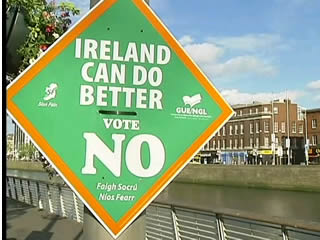 We Europeans have been struggling during over 150 years to achieve what we havfe today, a welfare state with many rights for our citizens and workers. The European Union has helped to achieve this common wealth across the countries which are members. Neither Spain nor Ireland would be as wealthy as they are today if it weren't for the EU funds, so we all should praise the work the EU has done for its citizens.
Until now. The EU constitution was a rip-off which took away many of the hardly earned rights and a confirmation the EU was the Europe of the States instead of the Europe of the people. Thankfully, both France and the Netherlands voted no to it and it was dropped off the political agenda. But the EU governments hadn't said their last word and they invented the treaty of Lisbon, which is a new constitution without the name. This time, to avoid surprises as the constitution gave, they have mainly decided to vote it inside the respective parliaments, not by giving the voice to the people with a referendum. Since politicians where the ones who created the treaty the results have not surprised anybody, yes was the result in all countries. What a great example of democracy. But Ireland has chosen the truly democratic way and has organised a referendum which is being voted today. If the result is no they will stop the treaty and all the EU working class will be grateful to their Irish colleagues.
The EU is not exiting any more, a dark shadow of neo-liberalism has been put over it and it seems to have forgotten the rights and welfare of its citizens. Not only because the the constitution or the new treaty, also the new law which allows a worker to do a 65(!) hours a week schedule. Almost worse than in the 19th century. I don't feel encouraged by the EU any more.
Because we love the EU, Ireland vote no!
Update: The result has been no!
Friday, 6 June 2008
Boycott to Air Berlin
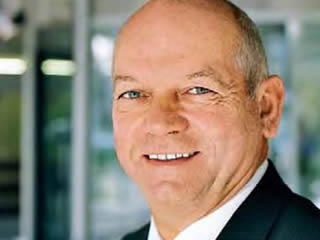 Outrageous. A shame. Unbelievable. And amongst all sad. The president of Air Berlin has written the editorial of the in flight magazine of his airline putting down my language and the language of ten million people, Catalan. The government of Majorca, one of the places where Catalan is spoken, kindly asked him if he could train his workers and adapt his services to include Catalan in the flights leaving or departing from Majorca. His answer has been to discredit and diminish Catalan language saying a bunch of lies like that Spanish language is almost banned from the public life, when everybody knows that the weak language is Catalan. What I wander is, why is this monstrosity of human being mettling in internal affairs which have nothing to do with his business? Maybe is he some kind of German Imperialist wanting to invade Majorca? And, putting myself to his same low level, is maybe an unrecycled Nazi wanting to recover the Third Reich which would include the Balearic Islands as a holiday resort? Each place has its problems and nowhere external intrusion is welcomed. You can see the article (in german) here or in Catalan here.
I shall never take an Air Berlin plane until a formal apology is made and this pillock is fired from the company. I encourage everybody with some dignity to do the same, not take any Air Berlin plane, it doesn't matter if you are Catalan, German, Scottish or French. If you want to communicate with Air Berlin to tell them how you feel about this issue e-mail them. Another option is to use the model given here (in Catalan).
Some related links in the news:
- La Vanguardia (Spanish) / Another article
- E-Noticies (Catalan)
- 3cat24 (Catalan)
- Avui (Catalan)
- El Mundo (Spanish)
- El Periodico (Catalan)
Thursday, 5 June 2008
Change the attribute name of a column in ArcGIS
ArcGIS is a very useful and powerful programme, but sometimes its so complex that to do a very simple thing can become a nightmare. Today I wanted to change the attribute name of the columns of the attribute table in ArcMap because after messing around with a shapefile I had ended up with some funny names. The problem came when I tried to do it and I realised I didn't know how to change the name of the attribute. I thought that by clicking it or just right clicking I would be able to adapt the headings to my desired option. But I was wrong. I went nuts trying many options, exporting the table and open it in Excel, open it with a text editor, using SPSS,... I even downloaded the program DBF Manager to change it, but it was useless. It has been then when I have discovered how to do it.
It is very simple, you just have to go to properties in the layer menu (right click the layer name to access it):
It is very simple, you just have to go to properties in the layer menu (right click the layer name to access it):

And then go to the Field tag. You will only be able to change the alias of the table, but it should be enough because is what you see in the attribute table.

In my discharge I shall say I had found that menu at first, but when I tried to change the name, not the alias, so I thought it didn't work that way. This has been tested in ArcGIS 9.1 and 9.2
Wednesday, 4 June 2008
How to know the IP address of a visitor

You can know your IP address by creating a PHP file in your server with the following text in it:

There are other functions associated to the $_SERVER array like knowing the browser used to access your webpage. This can be useful to know which is the most used browser to surf your page and design it having it in mind to benefit the majority of your visitors (some webpages look quite different depending of the browser used). You can get a full table of the different functions $_SERVER has by creating a PHP file with the following code in it (remember to open it from your server, otherwise it won't work). If you run this file from your computer you will know everything about it and about your server.

Keep in mind that to use this you must have a server with PHP.
Tuesday, 20 May 2008
Raven, by Edgar Allan Poe

While speaking with my girlfriend about a short-stories book I remembered one of the best pieces of English literature I know of, Raven from Edgar Allan Poe. I had read a translation to Catalan before and I really liked it, but after reading the original version I am speechless. The special use of alliterations and rhymes make a very musical yet powerful poem, one you have to read on a dark night with the only light of a candle when a thunderstorm is pounding outside the window. For those who have never read it or what to read it again here is a link to it and the first paragraph so you want to continue reading.
You can find the rest of it here: The Raven
Once upon a midnight dreary, while I pondered weak and weary,
Over many a quaint and curious volume of forgotten lore,
While I nodded, nearly napping, suddenly there came a tapping,
As of some one gently rapping, rapping at my chamber door.
`'Tis some visitor,' I muttered, `tapping at my chamber door -
Only this, and nothing more.'
Over many a quaint and curious volume of forgotten lore,
While I nodded, nearly napping, suddenly there came a tapping,
As of some one gently rapping, rapping at my chamber door.
`'Tis some visitor,' I muttered, `tapping at my chamber door -
Only this, and nothing more.'
Tuesday, 13 May 2008
Ubuntu 8.04, at last a Linux for Windowers
 Even though it was released some weeks ago I hadn't had time to install and test the new Ubuntu release known as Hardy Heron. I don't have a lot of experience working with Linux environments, I used to have Kubuntu 7 installed in my computer, but a re-installation of Windows deleted the entrance paths to it and I had to format it, but never bothered to install it again. Apart of that I have been working during the last year with a command-based Linux version -I don't know which one- at the university. The problem was that I found Windows easier to use and since I've grown accustomed to it I found Linux too much of a change.
But not anymore. In my opinion the new release of Ubuntu will be the good one to allow the transfer of users from Windows to Linux. The graphical interface is amazing, is very intuitive to use, it's available in many languages (like Catalan :)) and it comes with all the applications any standard user may need, like an Instant Messenger, Firefox 3, text processor, spreadsheet, sideshow editor, many games and a lot of other things. I have fallen in love with it. I run it from an external USB HDD and works perfectly and fast (I would like to see Windows doing the same), in fact I am typing this post in my Ubuntu environment and no problems at all.
Even though I really like it and I have good feeling about its success it still has some issues other Linux versions have, like some computers don't seem to like having Linux in them (I am lucky because mine was specifically designed to work perfectly with both OS) or that a lot of software it is still designed to work only with Windows and not with Linux. I any case, a great step forward.
You can download Ubuntu by clicking here. Here you can see a demonstration of how it looks before you choose to install it (this video uses the compiz extension, but is the same one I use and it is very easy to install):
Friday, 2 May 2008
Highlands breakdown
On Sunday we headed towards the Scottish Highlands to spend some days visiting a part of Scotland we hadn't seen yet. The trip was going great, we visited the Devil's Elbow, Balmoral Castle, Aberdeen, Peterhead and when we were heading towards Inverness we stopped for a second in Burghead, a little town close to Elgin. The exact point where we stopped can be seen in the map below. We stopped here because there is a Picti Fort right at the left. The problem is that the fort is not even ruins, it says it was a fort and you have to believe so, because there was nothing which resembled a fort.
Mostra un mapa més gran
When I tried to lock the car the central locking went on and off very fast, and when I tried to close it again the remote key didn't work. I thought it was the battery of the key, so I didn't worry about it. After seeing the grass field supposed to be a fort I headed back to the car and tried to start it. And from there everything went wrong. The car wouldn't start. I tried to push the car down a slope and start by changing gears, but it wouldn't start either. I tried for a while and when I gave up I called my road assistance service.
My road assistance is given by the Catalan company RACC and I just love the service they give, it is just awesome, I highly recommend it. They sent me two tow trucks, one to try to fix the breakdown on the spot (it was a blown fuse and he didn't have one) and another one to tow me to Inverness and to find a hotel.
When I woke up in the morning I walked to Ness Motors Inverness, the official Renault service in Inverness. When they told me they were full for the day so they could not help me, maybe the next day or the other I freaked out, I thought I would stay forever stuck in Inverness. At noon I had to buy another night in the hotel and I just didn't want to spend the whole week up there, so I phoned Ness motors every two ours begging to look at the car and fix it, because I was in a hurry and it was not a major failure. Before they closed I popped by and ask for my car. I was ready to get mad and then they gave me my car back, and fixed, I was so happy I wanted to kiss the car when I sat back in. The next day we came back to Edinburgh.
I want to finish by thanking a good Samaritan who helped me when I first realised the car was broken in Burghead. He was passing by and I asked him where could I find a mechanic. He told me the town's mechanic was closed, but a while after leaving he came back and asked us if we wanted to go spend the night at his house. I refused his offer, but I was extremely thankful to him. I don't know your name, but thank you!
My road assistance is given by the Catalan company RACC and I just love the service they give, it is just awesome, I highly recommend it. They sent me two tow trucks, one to try to fix the breakdown on the spot (it was a blown fuse and he didn't have one) and another one to tow me to Inverness and to find a hotel.
When I woke up in the morning I walked to Ness Motors Inverness, the official Renault service in Inverness. When they told me they were full for the day so they could not help me, maybe the next day or the other I freaked out, I thought I would stay forever stuck in Inverness. At noon I had to buy another night in the hotel and I just didn't want to spend the whole week up there, so I phoned Ness motors every two ours begging to look at the car and fix it, because I was in a hurry and it was not a major failure. Before they closed I popped by and ask for my car. I was ready to get mad and then they gave me my car back, and fixed, I was so happy I wanted to kiss the car when I sat back in. The next day we came back to Edinburgh.
I want to finish by thanking a good Samaritan who helped me when I first realised the car was broken in Burghead. He was passing by and I asked him where could I find a mechanic. He told me the town's mechanic was closed, but a while after leaving he came back and asked us if we wanted to go spend the night at his house. I refused his offer, but I was extremely thankful to him. I don't know your name, but thank you!
Thursday, 17 April 2008
Side effects of the London Congestion Charge


As I said before in the blog, I have recently visited London. I had already been there some years ago, when no Congestion Charge was applied and the law has really changed the looks of the streets. For those who ignore what the Congestion Charge is, just say that is a fee for some motorists travelling within those parts of London designated as the Congestion Charge Zone.
This law has created a funny situation. Now the centre of London is posher than ever before since only rich people can afford to pay the tax on a daily bases. I was amazed by the number of Mercedes Class S parked around the city, unbelievable, is there an offer that if you buy three the fourth is free?. Another side effect of the law is that electric and hybrid cars are exempt of paying it, so the city is full of Toyota Prius and some sort of wee car called G-Whiz, an electrical and quite ridiculous car. Finally, I was amazed by the amount of mopeds ad motorcycles around. Since they don't have to pay the tax many people has chosen to circulate by motorcycle. It's funny, because I had never seen so many motorcycles on a northern Europe city (even though is far from the numbers of Barcelona). In conclusion, many times laws have weird side-effects that can deeply change the looks of a city.
This law has created a funny situation. Now the centre of London is posher than ever before since only rich people can afford to pay the tax on a daily bases. I was amazed by the number of Mercedes Class S parked around the city, unbelievable, is there an offer that if you buy three the fourth is free?. Another side effect of the law is that electric and hybrid cars are exempt of paying it, so the city is full of Toyota Prius and some sort of wee car called G-Whiz, an electrical and quite ridiculous car. Finally, I was amazed by the amount of mopeds ad motorcycles around. Since they don't have to pay the tax many people has chosen to circulate by motorcycle. It's funny, because I had never seen so many motorcycles on a northern Europe city (even though is far from the numbers of Barcelona). In conclusion, many times laws have weird side-effects that can deeply change the looks of a city.
Subscribe to:
Posts (Atom)


