Showing posts with label Politics. Show all posts

Friday, 17 October 2008

Crisis (2): 1929

Article written by Xavier Sala Martí (Columbia University) in La Vanguardia, a Catalan newspaper. Translated from Spanish to English using Babel Fish (sorry for the translation mistakes, if you want to suggest any change leave a comment).

The global financial crisis has sown panic about the state of the global economy. Many analysts compare the situation with the Great Depression of 1929. We remind investors episodes of rushing through the windows on Wall Street and queues of hungry Americans begging on the streets of New York. Even my colleague from Columbia, Joe Stiglitz, said that the fall of Wall Street capitalism is what the fall of the Berlin Wall was to communism. Stiglitz's words are a great intellectual contribution to the debate, because it demonstrates once and for all that the prize awarded to Nobel no vaccine against the ability to say nonsense.

Let's see, let us be serious: neither the financial crisis represents the end of capitalism or we face a new Great Depression. The current situation resembles that of the 29 in two essential aspects. The first is that stock markets have fallen. Yes. So what? Many people have lost money and that's sad. But from there to be a looming Great Depression half an abyss. Statistically, short-term movements of stock markets do not reflect the real state of the economy, especially during episodes like the current ones, in which investors have entered the stock market in a state of hysteria that prevents them from seeing things clearly.

That said, there are six major differences between the crisis of 1929 and the present. First: in 1929 the bank deposits were not insured.

When the crisis began, all the families rushed to find their savings to their banks. These, of course, did not have the money because it had provided (that is, precisely, their business), so they could return and were left without resources when the doors closed. Millions of Americans lost their savings. None of this will happen in 2008 because the deposits are insured, precisely, thanks to the lesson of 1929.

Second: in 1929 the monetary system was based on the gold standard, which prevented the Federal Reserve (FED) increased liquidity in the system if not previously increased its reserves of gold. As the gold held by the Fed did not increase, this could not print the money that disappeared because of bank failures. In 2008, central banks around the world are printing money to provide liquidity to the financial system.

Third: in 1929 there was deflation and prices and wages were falling continuously. That meant that the debts were inasumibles family: if one has a debt of 100 and a salary of 300, one can pay.

But if the wage goes down to 100 and the debt remains the same, one ends up not being able to pay. That worsened the financial problems of banks. In 2008 not only there is no deflation but there is inflation.

Fourth: the per capita income of U.S. in 1929 stood at about 6,000 dollars (in current prices). Today exceeds $ 36,000. A fall in income from 25% when you win 6000 poses serious problems of famine. The same drop when you win 36,000 is a problem, but does not generate humanitarian disasters.

Fifth: the U.S. reaction to the crisis of 1929 was to blame foreigners and promote purchases of American products by putting tariffs on imports (the infamous Smooth-Hawley tariff). Naturally, the reaction of foreigners was put tariffs on American products, which triggered a trade war that harmed at all. At present, despite some remaining globófobo haggard (and hairy), there are no documented economists propose protectionism as the solution to the crisis.

And sixth, and most importantly, there is a fact in which almost no one fixed but it is key: the rate of return on investment of non-financial sector. In the year 1929, that rate was 0.5%. That is, in 1929, if one was investing an U.S. dollars outside the banking sector, earning a return close to zero. In 2008, return on investment in non-financial sectors is ... 10%! To become an idea, the rate of return average for the past 50 years has been 7%. This is very, very important, because while economic growth in a country not preceded by increases in the bag, yeah ... has been preceded by high rates of return in the financial sector! To understand: While Wall Street has done its financial follies, Silicon Valley has continued to innovate, and that, ultimately, is what determines the growth of the economy. That means that when the financial regain sanity, capitalism not only not disappear but that the U.S. economy will come out fired toward a new growth path.

Ah! I almost forgot. I said that there were two factors that made the crisis of 1929 and the present were similar. I have one already commented: stock markets plummeted. The second: governments do not learn anything. One is left stunned when the Government approved a plan to purchase 700,000 million toxic assets of banks and a week later decides that the money will be used to buy shares. And one becomes even more petrified when he sees that the explanation given for this change is that ... the stock market has reacted negatively! That journalists will confuse the bag with the economy takes a pass. But the government used the bag to decide its economic policy is crazy that shows that he totally lost. Tan lost as of 1929.

Crisis (1): What has happened

Article written by Xavier Sala Martí (Columbia University) in La Vanguardia, a Catalan newspaper. Translated from Spanish to English using Babel Fish (sorry for the translation mistakes, if you want to suggest any change leave a comment).

The perfect storm continues its inexorable course and we all wonder what is the solution. Before talking about remedies, it is important to know what has happened because, without a proper diagnosis, there is no sensible solutions.

It all began in 2001 when Alan Greenspan wanted to avoid the collapse of the stock market after the fiasco of the dot-reducing interest rates from 6.5% to 2.5% in less than a year. With these guys so low, banks, who live in lending money in exchange for an interest, sought profitability in families with low incomes and with a high probability of being unable to repay the mortgage, calls families have an increased risk subprime.Al, those families pay a higher interest, although the banks thought the risk was mitigated by the fact that the price of their houses were going up: if one day they have problems, they thought, the families will be able to sell the house at a price higher than the mortgage, enabling them to return the money.

But they could charge the margins were so small that in order to obtain profitability, they had to multiply the volume. The problem is that the number of mortgages they could give was limited by regulation to Basel prevents credits granted by a bank exceed a certain proportion of their capital. Curiously, which does allow such regulation is that banks think about parallel investment funds (called under pressure) who buy their receivables. And so they did: the calling given under pressure, buying mortgages to the banks and those recovering the money. Having disappeared from their credit balances (to allow regulation and the Basel accounting of the bank and the conduit was made separately), banks could return to provide the same money, thus expanding the business.

The under pressure, in turn, the Prime Minister took the mortgages, the repackaging (in sophisticated language, title) in ways so complex that get ratings of AAA, which indicated minimal risk and sold to investment banks. To facilitate the operation, even got names pompous as insurance with credit default swaps.Los investment banks, in turn, used these assets as collateral to borrow additional leverage and more financial operations, thus creating a huge snowball of assets , No matter how sophisticated they were, were guaranteed the last of the families subprime mortgages.

And all this was going very well while the price of housing rose. But came a day left to climb. Families who had borrowed 100,000 U.S. dollars saw that his house was worth only 60,000 and had to make a decision: return home or return of 60,000 a mortgage of 100,000. No one should be very ready to see that if the regulation allows to choose, many will return home and not pay the mortgage. And it turns out that the regulation allowed to pick and, therefore, decided not to pay the late payment was fired and all assets secured by those mortgages began to lose its value and to be cataloged tóxicos.El problem is that they had been so many times that retitularizados nobody knew how many active or toxic or who had had. That created a mistrust between banks that made money no longer lend to each other. Interbank interest rates (such as the Euribor) was fired and, with them, the monthly payments of millions of families who stopped to pay their mortgages. Late payments rose, no longer among subprime families, but among the families in the world. Insurers had to pay it insured ... but did not have enough money, so they were the first to break. Their names: Bear Stearns, Freddie Mac, Fannie Mae and AIG. Does it sound like?

And here again to see the regulation of Basel: the investment banks like Merrill Lynch and Lehman Brothers had used such bonds now that were toxic as financial security and the regulation said that when the value of those securities down, banks were required to dispose of other assets and use the money to replenish the lost security. The problem is that this was happening right in the moment that nobody wanted to buy those assets at reasonable prices. But as they were forced to sell, sell. That ... To balance price! That increased their losses, which reduced the market value of its assets, which forced them to sell more, which increased their losses ... and so on in a negative spiral of losses and decreases in trading that led to bankruptcy. The financial panic was served.

Which brings us to the present time: the mistrust, fear and loss of the banks are doing that not only cease to lend to other banks, but will cease to provide a non-financial companies from around the world. Investment in the hospital sector in Germany or the food in Colombia are not carried out due to lack of funding. Economic activity falls, the jobs disappear and what began as a problem in the U.S. mortgage. UU. is getting to the real economy around the world. The public asked their governments to act. The erratic public policies they propose, however, show that they do not know what to do, which raises more distrust and aggravate the situation. That's what we will talk in a future article. For now, this is what happened.

Monday, 28 July 2008

Marginalised countries form list

I am sick and tired of not being able to select Catalonia when an Internet form asks to select my country. This is why I have had the idea of creating a country list form so everybody can suggest their 'invisible' country and I'll add them into the list. I have started by adding Catalonia, Scotland, Galicia, Basque Country, Wales, Quebec, Corsica and Tibet, but there are dozens of other countries not recognised internationally which could be inserted into the list, so please suggest some and spread the word so no country in the world is missed from this list. Please feel free to copy it and use it in your websites so everybody can select their country and are not marginalised anymore.


You can copy the code from here:


And see how it looks here:

These are the added countries:

Thursday, 12 June 2008

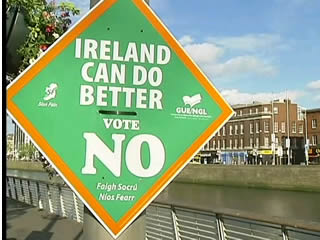
Ireland, we count on you

We Europeans have been struggling during over 150 years to achieve what we havfe today, a welfare state with many rights for our citizens and workers. The European Union has helped to achieve this common wealth across the countries which are members. Neither Spain nor Ireland would be as wealthy as they are today if it weren't for the EU funds, so we all should praise the work the EU has done for its citizens.

Until now. The EU constitution was a rip-off which took away many of the hardly earned rights and a confirmation the EU was the Europe of the States instead of the Europe of the people. Thankfully, both France and the Netherlands voted no to it and it was dropped off the political agenda. But the EU governments hadn't said their last word and they invented the treaty of Lisbon, which is a new constitution without the name. This time, to avoid surprises as the constitution gave, they have mainly decided to vote it inside the respective parliaments, not by giving the voice to the people with a referendum. Since politicians where the ones who created the treaty the results have not surprised anybody, yes was the result in all countries. What a great example of democracy. But Ireland has chosen the truly democratic way and has organised a referendum which is being voted today. If the result is no they will stop the treaty and all the EU working class will be grateful to their Irish colleagues.

The EU is not exiting any more, a dark shadow of neo-liberalism has been put over it and it seems to have forgotten the rights and welfare of its citizens. Not only because the the constitution or the new treaty, also the new law which allows a worker to do a 65(!) hours a week schedule. Almost worse than in the 19th century. I don't feel encouraged by the EU any more.

Because we love the EU, Ireland vote no!

Update: The result has been no!

Friday, 6 June 2008

Boycott to Air Berlin

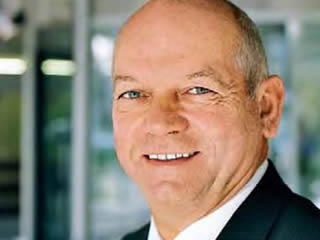
Outrageous. A shame. Unbelievable. And amongst all sad. The president of Air Berlin has written the editorial of the in flight magazine of his airline putting down my language and the language of ten million people, Catalan. The government of Majorca, one of the places where Catalan is spoken, kindly asked him if he could train his workers and adapt his services to include Catalan in the flights leaving or departing from Majorca. His answer has been to discredit and diminish Catalan language saying a bunch of lies like that Spanish language is almost banned from the public life, when everybody knows that the weak language is Catalan. What I wander is, why is this monstrosity of human being mettling in internal affairs which have nothing to do with his business? Maybe is he some kind of German Imperialist wanting to invade Majorca? And, putting myself to his same low level, is maybe an unrecycled Nazi wanting to recover the Third Reich which would include the Balearic Islands as a holiday resort? Each place has its problems and nowhere external intrusion is welcomed. You can see the article (in german) here or in Catalan here.

I shall never take an Air Berlin plane until a formal apology is made and this pillock is fired from the company. I encourage everybody with some dignity to do the same, not take any Air Berlin plane, it doesn't matter if you are Catalan, German, Scottish or French. If you want to communicate with Air Berlin to tell them how you feel about this issue e-mail them. Another option is to use the model given here (in Catalan).

Some related links in the news:
Shame on you mr. Hunold, shame on you.

Friday, 4 April 2008

The loneliness of Zapatero


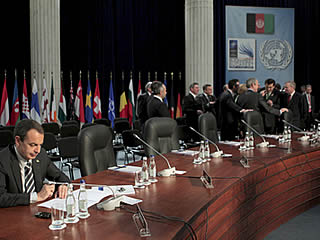
In Catalonia (and in half of the world) to get even the crappiest jobs some sort of foreign language knowledge is required. This rule applies to all sorts of jobs except to politicians, because most Catalan and Spaniard politicians are monolingual. The president of Catalonia only speaks Spanish, not even Catalan, which he is learning at the moment, even though he has lived in Catalonia almost all his life. The former president Aznar was ridiculous when he tried to speak English, but his successor Zapatero is as bad or worse. He only speaks Spanish, nothing else. I wonder why there isn't a list of minimum requirements to be president of a country and I have to study like crazy to find a good job in the future. I speak, read, and understand four languages, why can't politicians do the same.

But Zapatero (as Aznar, Gonzalez or Montilla) has found out what happens if you are half-illiterated and you become a ruler, you end up being the target of all jokes. Just look at the following videos, in the first one, recorded yesterday he is isolated from all the NATO leaders because he is not able to communicate with any of them. Indeed a very useful country representative. The other two videos don't need comments.


Wednesday, 5 March 2008

Ministry of Foreign Affairs of Spain, here to ignore you

When a person lives in his home country, the ministry of foreign affairs is only useful to declare wars, sign treaties or visit other countries to tighten bounds, so it is not awfully useful.

Since a lot of money is spent in this ministry, one thinks that the service given to the citizens living abroad should at least be correct. But the Spanish one it isn't, it must be one of the crappiest services of the world. Let's start with the electoral services for example. One of the main duties of embassies and consulates is to allow the citizens living abroad to vote in the elections held back home. When I lived in Catalonia each time there was an election in Ecuador, Colombia, Venezuela or other countries people where allowed to vote in the consulate of Barcelona. Spain does not allow to do so, you are forced to vote by mail. This means that to vote you have to do a long and complicated process which starts over a month before the elcetion is held and that involves to go at least twice to the consulate (or embassy) and send the vote by mail. A pain in the ass altogether.

But that is not the worse thing about the Spanish consulates and embassies, the most horrible thing is that the service they prove sucks, its horrible, in fact it could be said that they do not any serviced at all. If you have a problem of any sort they will say: "It is none of our business" or "the consulate is not here to help you in that issue", but the problem is that never is of their business so they never help you.

Let's start with Spanish Consulate of Edinburgh, because is the one I know best. When I came here I had some legal problems and the web page of the consate said that they could help me with that. When I asked for aid their answer was: "it has nothing to do with us", great. A friend's credit card became demagnetised and she went to the consulate to see if they could help her calling to the bank to see how it could be sorted out, they didn't give any help and didn't allow her to use the phone to call to a free(!) number, awesome. In fact nobody that has used the consulate here that I know of, has received any help at all from them.

But the problem is not Edinburgh's consulate, everywhere is the same. I've heard similar situations from Germany, from Manchester, from London, from Paris, and from Rio de Janeiro, where they won't be able to vote because the ballot papers have not been sent yet. All together a shame that moves all Catalans abroad towards willing to be independent from a state that is non-functional.

On the other hand, here in the UK there are commercials on TV from the British Ministry of Foreign Affairs Embassies with the slogan, "we are here to help". What a difference. If Spain was to do the same the slogan could be "we are here to ignore you"

P.S. The picture is from our "great" minister of foreign affairs, mr. Angel Moratinos. An example of "intelligence" and "savoir-faire".

Wednesday, 27 February 2008

Is the law equal for all?

On the 9th of March, Spain is having general elections to choose the president and the parliament. It would be the equivalent to the elections where Britons chose Tony Blair. Since I'm outside of Catalonia, I had to go to the Spanish consulate to say that I wanted to vote, and after waiting for a couple of weeks, yesterday I received an envelope. In the envelope there were all the ballot papers from all the political parties running for election. Even though only around ten parties achieve to get representation in the parliament, there are dozens of candidates from very tiny parties. I am interested in politics, so I know most of the parties and their political ideas, but I had never heard from some of the candidates, so I googled them to find out what their proposals are.

I was shocked when I entered the web page of alianza nacional, a fascist party that is running for election. I find it offensive that a party that defends racism and Nazism, that enhances the figures of Franco, Hitler and Mussolini is allowed to run for election. The police should put all of them into jail, they are like a terrorist party and they should be treated like that. And the European Union allows the nonsense of the Spanish government? Nobody has realised that Nazis are a legal and a political organization in Spain? In case someone has doubts about the ideology of this bunch of scum you can see their promotional videos here, with their fascist aesthetics, their fascist flags and their swastikas.

What worries me the the most is that this shows that in Spain the law is not equal for everybody, because political parties like Batasuna or ANV, which support the independence of the Basque Country have been made ilegal because they didn't condemn the terrorism of ETA. I am sure that alianza nacional does not condemn fascism or the holocaust, so why are they legal? Isn't the law supposed to be equal for everybody? I suggest a campaign to make this political party illegal together with other ones like falange, falange autentica or democracia nacional. E-mails should be sent to the Inner Affairs Ministry of Spain and to the European Union to lobby so that bunch of racists and Nazis are wiped away from the legal system.